

Empathy 101
A guide for anyone struggling to understand perspectives outside their own

Last week, I wrote about the ICE raids and how hard it’s been to think about anything else since. Lately, I’ve been sitting with the idea of empathy—how we talk about it, how we practice it, and where we fall short. I said I'd write more at the end of that last piece. So, class is in session.
At first, my take was simple: we all need to be more empathetic. That’s still true. But then Heather posted a video on TikTok that pushed me to think deeper, and we’ll get to that. For now, welcome to Empathy 101.
I don’t want to insult anyone's intelligence, but let’s reset the room and align on the word’s definition so we can all be on the same page. Merriam-Webster defines empathy as “the action of understanding, being aware of, being sensitive to, and vicariously experiencing the feelings and thoughts of another.”
Most people I know are good at noticing emotions. They can read a shift in tone, catch a change in body language, or clock a look across the room. However, fewer people understand why someone feels what they feel or how to hold that with care.
That’s where being a Black woman has given me an edge. My survival has depended on reading the room, even when I don’t want to. Even when I don’t think someone deserves my grace, I still seek understanding of the situation.
Let’s talk politics for a second. It’s at the top of my mind and is a helpful example.
I’m from a primarily white, conservative town in Ohio. I went to Kent State University, a liberal campus known for protesting the Vietnam War in the ‘70s. Ironically, the campus seemed more progressive then than it is now. Recently, the school eliminated programming at the Women’s Center, LGBTQ Center, and Multicultural Center because of new DEI restrictions passed in Ohio.
Most of the people I hung out with in college came from predominantly white Republican suburbs, and that mindset didn’t disappear after graduation. And while I grew up in that same environment, I’ve never aligned with those politics.
A friend of mine put it this way:
"If you live in a city, you’re constantly interacting with different kinds of people. You share space, you share resources, and it forces you to think collectively. But if you live in the suburbs or more rural areas, you’re mostly in your own world. You don’t have to engage. Empathy isn’t required.”
It’s not how I came to empathy, but I can see how it plays out that way for many people. Being close to differences can change how you see the world.
Alright, let’s get to the lessons.

Many people can sense someone else’s emotions but stop short of actually engaging with them. We don’t want to enter the emotional arena because doing so might mean confronting our beliefs, which can include anything from classism to white supremacy.
Empathy makes you ask hard questions like, "Why does this make me uncomfortable?" or "Why does their experience annoy me?" That kind of self-awareness is hard. Most people want to hold on to the version of reality that feels most stable, even when it’s not rooted in truth.
As someone who is often the recipient of that avoidance, I can tell you it feels delusional. But I’ve developed enough empathy to know what’s happening: people get overwhelmed and emotionally shut down. They don’t want to sit in discomfort, so they pivot to avoidance. It’s easier to ignore reality than to do the hard work to unravel what is true.
We can do better. And honestly, we should.

We’re not born with it. We build it. And being empathetic to people who look, think, and live like you doesn’t count.
At a certain point, it’s lazy not to try to understand other people’s experiences, especially if you want to be in community with people whose experiences differ from you.
We all have work to do. The key is to keep trying.

It’s one thing to hear someone. It's another to let what they said shift how you move.
In my early 20s, I remember a gay friend telling me he is over going to straight bars. That might seem obvious now, but I didn’t think much of it then. He seemed like he was having fun when we were out. But when we talked more, he explained how uncomfortable it felt—not just the lack of romantic prospects, but the microaggressions and awkwardness.
Once he shared that, it clicked. After that, our nights out were mostly with the girls and the gays. A win for all, to be honest. The music was better, people danced more, and the drinks were stronger. I didn’t push back with, “Well, I want to go to XYZ.” I could still do that on my own time. That moment wasn’t about me; it was about honoring what my friend needed.
That’s what empathy looks like in practice.
I could keep going, but I’ll pause the lesson here.
To be real, I came to the page ready to rant about how people lack self-awareness and refuse to center anyone but themselves. But the truth is, I’ve had a head start. As a Black woman, my experience is rarely the norm, so I’ve spent my whole life trying to understand where other people are coming from—because I’ve had to.
I’m just a curious person. I want to understand people, even when I disagree with them.
That brings me back to Heather; she is why I didn’t turn this letter into a burn book about how people aren’t empathetic. Apparently, there are better ways to encourage behavior change.
Earlier this year, I met Heather at Erika Veurink’s coworking event, EV Study Hall. We talked about Becoming You—we’d both taken the workshop—and I’ve followed her ever since.
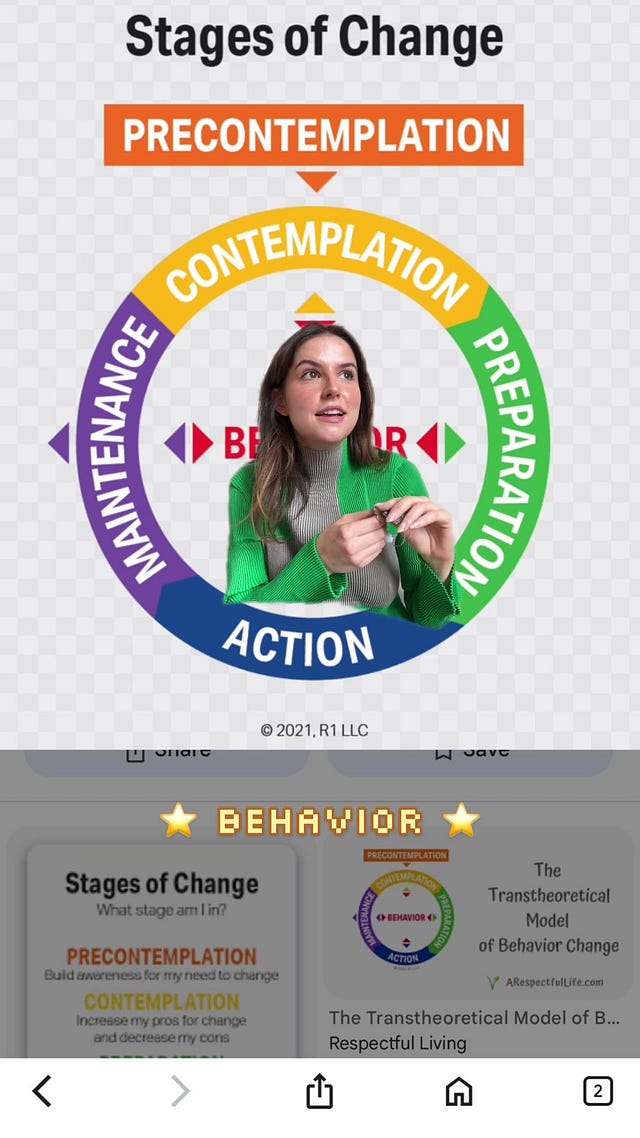
In a recent TikTok video, Heather broke down the Transtheoretical Model, which maps out how people change behavior. It was a lightbulb moment for me.
 Tiktok failed to load.
Enable 3rd party cookies or use another browser
The model outlines five stages of behavior change:
1. Precontemplation – You’re not even thinking about change.
2. Contemplation – You’re beginning to consider it.
3. Preparation – You’re getting ready to take action.
4. Action – You’re actively working on the change.
5. Maintenance – You’re committed to keeping it going.
After watching her video, I realized something: I spend most of my time, especially on this topic, in the preparation or action stages. I’m constantly ready to grow, to adjust, to do better.
But many people, especially when it comes to empathy, especially toward marginalized communities, are still contemplating, some are honestly in precontemplation.
That disconnect has been driving me up the wall. But seeing the model gave me language for the tension I’ve been feeling.
Some people are just waking up to what others have been screaming about for years. You’re already flexing the empathy muscle if you made it this far. Keep going!
Okay, class dismissed.
As always, thank you for reading Define Normal. You can always send me a message to continue the conversation! Otherwise, you can find me on IG, TikTok, or the Define Normal podcast.
You and @pig mami are a duo that could save the world